

OnlyFans chatter services handle the direct messaging and subscriber engagement work done on a creator's behalf. A chatter writes messages, sends promotional offers, and upsells pay-per-view content while representing the creator. In short: a chatter manages conversations so the creator doesn't have to answer every message personally.
That one-line definition solves the vocabulary problem, but not the larger one. If you're a creator researching agencies, "chatting" appears on nearly every service list. Almost nothing written about it addresses creators directly. Most results are job postings aimed at people who want to become chatters, not resources to help you decide whether to outsource your conversations. This guide fills that gap. It explains what chatting actually involves, how scope and persona should be documented, and what to ask before you sign anything.
What OnlyFans Chatter Services Include
An OnlyFans chatter service is the part of creator management where someone other than the creator writes and sends messages within the OnlyFans direct messaging system. This typically drives subscriptions, tips, and pay-per-view purchases. The person doing this work is called a chatter.
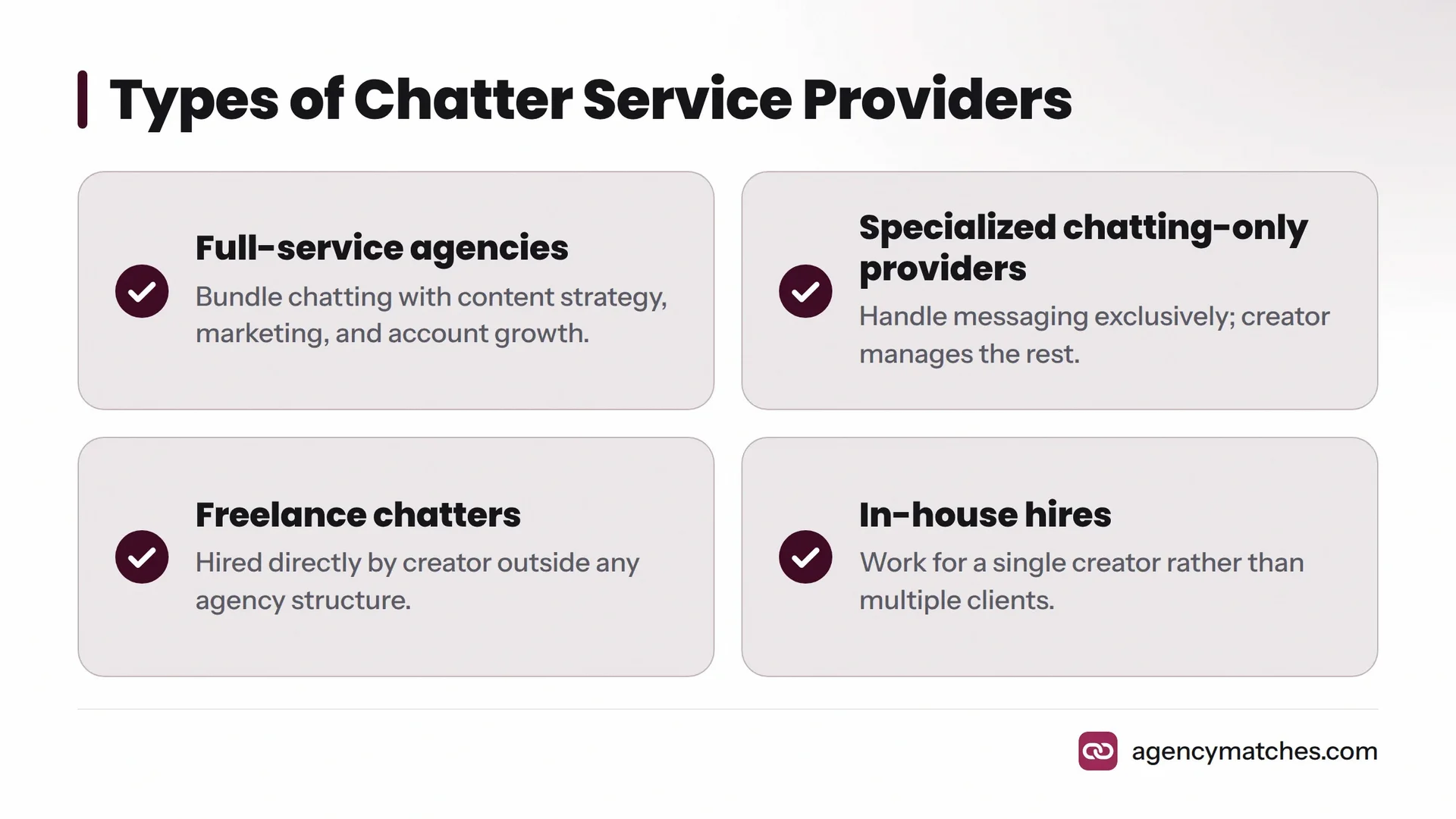
Chatters come from several different arrangements:
- Full-service agencies bundle chatting into a broader management package alongside content strategy, marketing, and account growth.
- Specialized chatting-only providers handle messaging exclusively and leave everything else to the creator or a separate team.
- Freelance chatters hired directly by a creator outside any agency structure.
- In-house hires who work for a single creator rather than splitting time across an agency's client roster.
Chatting is one service among several that an agency might offer, not the entirety of OnlyFans management. If you're researching the complete menu of services agencies typically bundle, that's a separate question. This guide stays focused on the chatting function itself. Similarly, commission structures and wage arrangements fall outside this scope; those details are tied to pricing terms published separately, not to this definitional guide.
What Chatters Do Day to Day
A chatter's job is conversational, repetitive, and sales-driven. Core tasks repeat across agencies that list chatting as a service, though the exact mix varies by creator and shift.
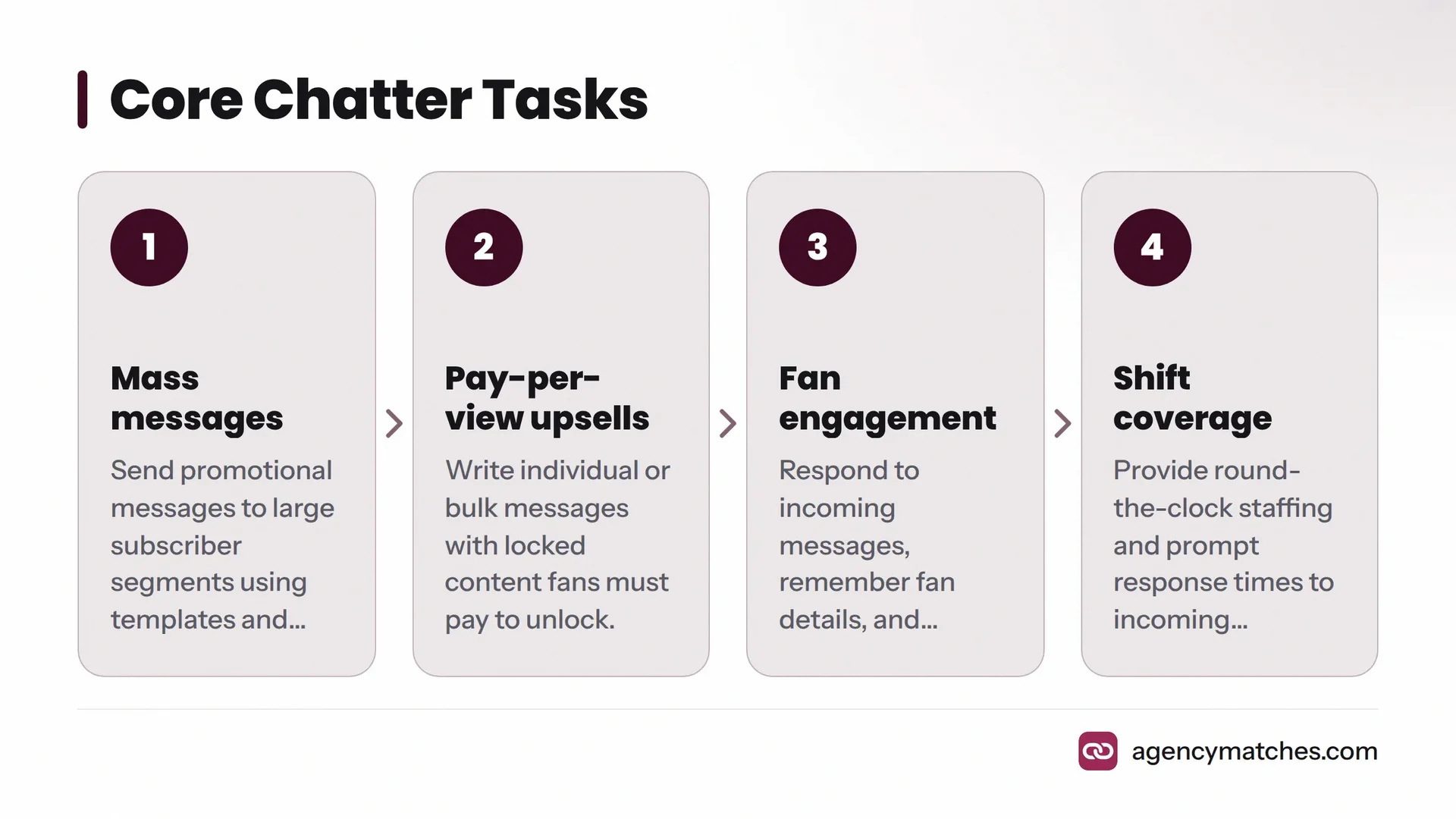
Mass Messages
A mass message (often abbreviated MM) is a single message sent simultaneously to a large segment of a creator's subscriber base, usually to promote a new photo set, video, or limited-time offer. Chatters draft these using a template or script, then adjust the wording and pricing based on what has converted well before.
Pay-Per-View Upsells
A pay-per-view (PPV) message is a direct message that includes locked content a fan must pay to unlock. Chatters write and send these individually or as part of a mass message, often following an upsell script - a pre-written structure designed to build interest before revealing the price. Timing and framing matter: a chatter working from a tested script typically paces the reveal differently depending on how a fan has responded to previous offers.
Fan Engagement and Relationship Building
Beyond sales messages, chatters respond to incoming direct messages, ask questions, remember details fans have shared, and keep conversations going. This task affects subscriber retention most directly. A fan who feels ignored or receives a generic, copy-pasted reply is far more likely to cancel a subscription than one who feels like someone is actually listening.
Shift Coverage and Response Times
Shift coverage means an agency staffs chatting across hours of the day, including overnight and weekend periods, so incoming messages get answered promptly rather than piling up. Response time expectations are the internal targets (stated or unstated) for how quickly a fan's message gets a reply. Agencies advertising round-the-clock coverage describe a rotation of chatters across time zones, not one person working continuously.
Common Chatter Tasks
- Drafting and sending mass messages to subscriber segments
- Writing and sending individual PPV upsell messages
- Following upsell scripts while adapting tone to the fan's responses
- Answering incoming direct messages and sustaining ongoing conversations
- Covering assigned shifts to maintain response time targets
- Flagging unusual, abusive, or high-value fan interactions to a supervisor
How Chatting Scope Gets Defined
Chatting scope is the written description of what a chatter is authorized to do: which message types they send, what pricing discretion they have, what topics or requests get escalated to the creator, and what's explicitly off-limits. A documented scope clause typically names the message categories covered, the approval process for new PPV pricing, limits on explicit requests the chatter can agree to, and the point at which a conversation gets escalated instead of handled directly.
Agreements vary widely in how much of this gets written down versus left as an informal understanding. Scope documentation ranges from detailed written clauses to a single vague line mentioning "chat support" with no further specification.
Documented vs. Undocumented Chatting Scope
| Documented Scope | Undocumented Scope |
|---|---|
| Named message types (MMs, PPVs, DM replies) listed explicitly | Chatting mentioned only as a general "service," with no categories named |
| Written limits on what a chatter can promise or price without approval | No stated pricing authority; left to chatter discretion |
| Clear escalation path for sensitive or unusual fan requests | No defined escalation process; handled ad hoc |
| Named review or approval step before new scripts go live | No mention of review before messages are sent |
| Stated shift hours or coverage windows | No coverage hours specified in the agreement |
Vague or undocumented scope is not automatically a sign of bad faith, but it is a risk worth noticing. Without a written definition of what a chatter can and cannot say on your behalf, there is no clear reference point if a disagreement comes up later about tone, pricing decisions, or promises made to a fan.
How Agencies Staff and Train Chatters
Chatting teams are rarely a single person. Most agencies structure the service around a small hierarchy and a repeatable onboarding process.
A team lead or chat manager oversees a group of chatters, assigns shifts, monitors conversation quality, and acts as the escalation point when a chatter is unsure how to respond. Chat team size varies: some creators work with one or two dedicated chatters, while others, particularly on higher-volume accounts, have a rotating team covering different shifts.
Training and onboarding commonly include:
- Reading through a creator's past messages or content to absorb the general style
- Reviewing a written tone guide or voice guide, where one exists
- Shadowing an experienced chatter or supervisor before handling live conversations
- A probationary period where a chat manager reviews outgoing messages before or shortly after they go out
- Ongoing spot checks of conversation threads to catch drift from the agreed tone or scope
Quality control in this context means the review process an agency uses to confirm chatters are following the script, staying within scope, and representing the creator consistently. This can range from a chat manager reviewing a sample of conversations each week to a more hands-off model where review only happens if a creator raises a complaint. The rigor of that review process is rarely advertised publicly, which is worth asking about directly rather than assuming.
How Persona and Voice Are Handled
Persona management is the effort to keep a chatter's writing consistent with how the creator would actually sound, so fans experience a coherent personality rather than a noticeably different voice from one conversation to the next.
The primary tool is the tone guide, sometimes called a voice guide: a written reference document describing the creator's vocabulary, emoji habits, sentence length, typical greetings, topics to avoid, and preferred ways of declining requests. For example, a tone guide might specify that a creator never uses certain slang, always opens new conversations with a particular greeting, and avoids discussing specific personal topics regardless of what a fan asks.
How much creators get to review chatter-written messages before or after they're sent varies. Some arrangements include a standing option for the creator to read transcripts on request. Others operate with minimal creator visibility once the chatter is handling the account day to day. This circles back to why scope and review rights are worth getting in writing up front.
How Agencies Disclose Who Is Chatting
Two separate questions matter here, and it's worth keeping them apart.
Disclosure to fans is whether the person on the other end of a conversation is told, explicitly or implicitly, that they're messaging a chatter rather than the creator. Disclosure to creators is whether the creator is told, at any given time, exactly which person on an agency's team is handling their account's conversations.
Across publicly available terms and materials reviewed for agencies, disclosure practices are inconsistent and frequently left unstated. Many agencies do not address, in public-facing materials, whether fans are informed a chatter is responding instead of the creator. Creators are not always told which specific chatter, or how many, are actively working their account during a given shift. This is a documentation gap rather than a confirmed industry-wide practice in either direction. It is exactly the kind of detail worth asking about directly before agreeing to a chatting arrangement, since public pages rarely spell it out.
Questions Creators Should Ask Before Agreeing to Chatting
Before agreeing to any chatting arrangement, whether through a full-service agency or a standalone chatting provider, use this checklist of direct questions. Treat this as a starting point, not an exhaustive legal review.
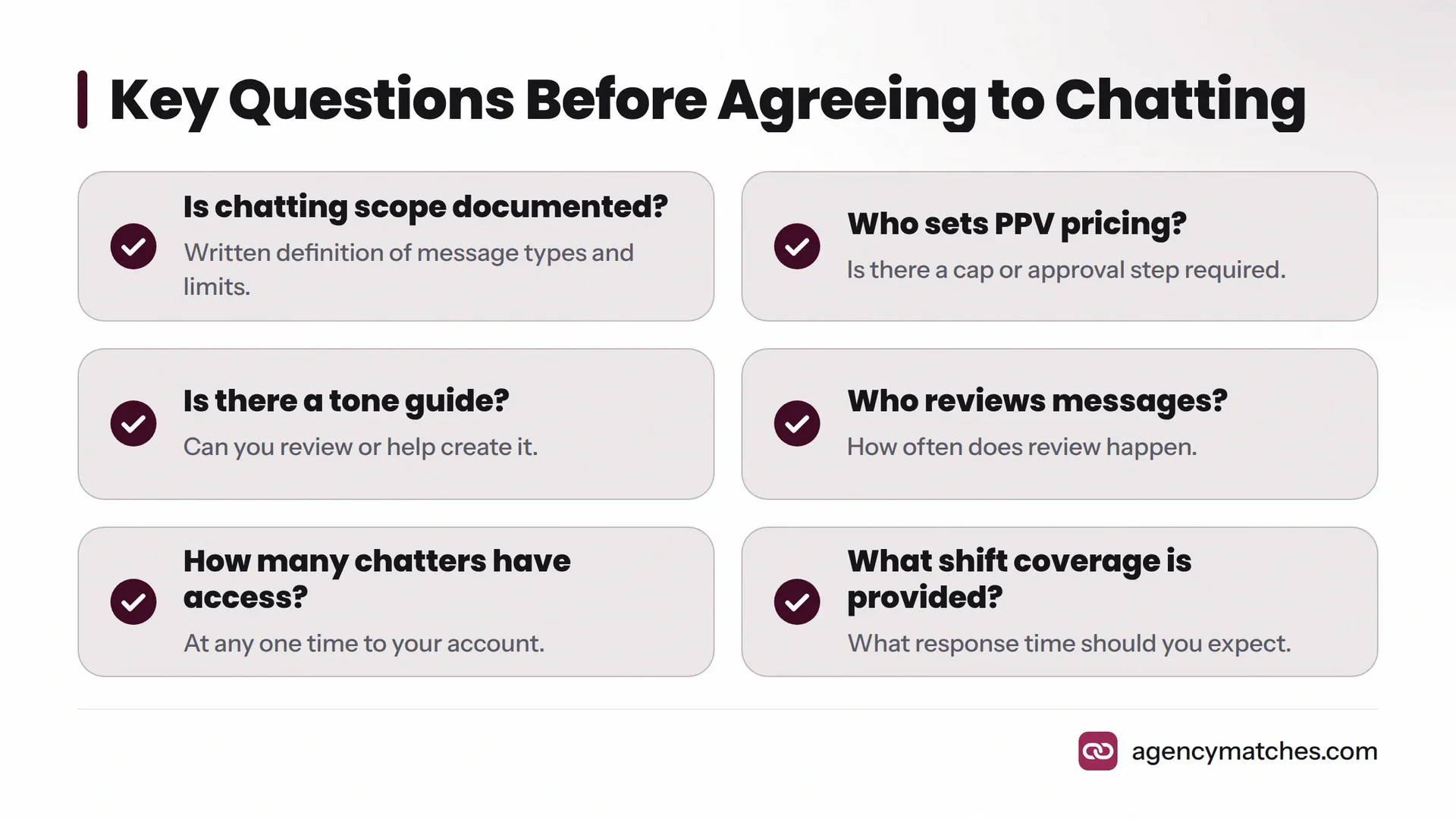
- Is the chatting scope documented in writing, including which message types are covered?
- Who has pricing discretion for PPV messages, and is there a cap or approval step?
- Is there a written tone guide or voice guide, and can I review or help write it?
- Who reviews chatter-written messages, and how often?
- How many chatters will have access to my account at any one time?
- What shift coverage is provided, and what response time should I expect from fans' messages?
- Are fans told, in any way, that a chatter rather than the creator is responding?
- Will I be told which chatter is working my account during a given shift?
- What happens if a chatter sends something off-script or outside the agreed scope?
- Can I request a transcript or log of recent conversations on request?
Getting clear answers to these questions, ideally in writing, does more to protect your voice and your subscriber relationships than any verbal assurance about how experienced a chatting team is.
Related Topics to Explore
This guide stayed tightly focused on what chatting is and how it typically works, which means a few closely related questions got deliberately set aside. If you're researching further, explore the full range of services an OnlyFans management agency might bundle together, the basics of how OnlyFans agencies operate as a category, who pays for chatting labor and how that shows up in commission structures, who retains control over account access once a chatting team is involved, and the different agency models (full-service, chatting-only, hybrid) that rely on chatters to varying degrees.
For a structured starting point on vetting any agency beyond its chatting practices, the practical checklist for choosing an OnlyFans agency walks through a broader set of questions. If you want to see how commission and fee structures are actually published across agencies, the fee calculator and cost guide is a useful companion to this piece. And if you're trying to figure out whether hiring any kind of agency makes financial sense for your account size, Are OnlyFans Agencies Worth It? breaks down the break-even math.
Frequently Asked Questions
What does "chatting" mean in an OnlyFans agency context? It refers specifically to the messaging and engagement work done through OnlyFans direct messages, including mass messages, PPV upsells, and fan replies, handled by someone other than the creator.
Is chatting the same as account management? No. Account management is typically a broader bundle of services that can include content planning, marketing, analytics, and growth strategy, with chatting as one component rather than the whole package.
Can a creator request to see chat logs? Many arrangements allow this, but it is not universal or guaranteed. Whether transcript access exists, and how easily it can be requested, is a detail worth confirming before agreeing to chatting services rather than assuming afterward.
How is a chatter different from a content creator? A chatter handles conversations and sales messaging on a creator's behalf. They typically do not appear on camera, produce content, or make creative decisions about what gets posted. The creator remains the person behind the account's content and identity.
Do chatters write in the creator's exact voice? That is the goal when a tone guide or voice guide exists and is followed consistently, but execution varies. Without a documented guide and a review process, drift from the creator's actual voice becomes more likely over time.
A Neutral Starting Point, Not a Recommendation
Agency Matches publishes this explainer as a neutral resource and does not endorse any specific chatting provider or agency. Where this article describes common patterns in scope documentation, staffing, or disclosure, those observations come from reviewing publicly available agency terms and profiles, not from first-hand operational experience running a chatting team. They are not a quality rating or an earnings guarantee for any provider.
If you're ready to compare how different agencies actually document their chatting scope, staffing, and terms side by side, the directory of OnlyFans and creator agencies on Agency Matches lets you filter by published terms rather than marketing claims. It remains the most direct way to see which agencies put their chatting practices in writing and which leave it vague. Start from the Agency Matches homepage if you want the full rankings context first.
For background on how direct messaging fits into the broader OnlyFans platform, the Wikipedia entry on OnlyFans covers the platform's subscription and messaging structure at a general level.