

An OnlyFans agency termination penalty is a financial charge, clawback, or contractual obligation that activates when a creator ends a management agreement. It may appear as a flat exit fee, a share of future earnings, or a demand to buy back content. The penalty typically triggers when a creator leaves before a minimum term ends, misses a required notice period, or unknowingly triggers an auto-renewal clause.
The real problem: not all agencies disclose these terms clearly before signing. Most creators approach a management contract the way they'd read a gym membership form - quickly, without imagining the exit. This guide breaks down exactly what each penalty type is, explains what actually triggers it, and provides a practical checklist for reviewing your agreement.
What Is an Agency Termination Penalty?
An agency termination penalty is any financial charge, clawback, or contractual obligation that activates specifically because a management relationship is ending. It sits separate from the ordinary commission the agency earns on content sales while actively representing a creator.
The distinction matters. A standard commission fee is the agency's ongoing cut of subscription and tip revenue - the price of the service while it's running. A termination penalty only exists at the exit.
Scope note: This page explains what these clauses are and how they work. It is not legal advice. Whether a specific clause in your contract is enforceable depends on your jurisdiction and the exact wording. A licensed attorney reviewing your actual agreement is the only reliable source for that answer.
Seven Common Penalty Types
Creator management contracts adapt penalty language from standard commercial agency and talent-management agreements, then modify it for a business built on recurring revenue and exclusive content.
Early termination fee. A flat or formula-based charge for ending the agreement before a minimum term expires.
Liquidated damages clause. A pre-agreed dollar amount or formula the leaving party owes, meant to estimate the agency's loss upfront rather than requiring proof of actual damages later.
Content buyout clause. A requirement that the creator pay to reclaim ownership or exclusive rights to content the agency helped produce, edit, or promote during the term.
Tail commission. A continuing share of revenue the agency collects for a defined period after termination, usually tied to subscribers or deals the agency originated while the contract was active.
Non-compete penalty. A charge or legal claim triggered if the creator signs with a competing agency or works independently in a restricted way within a defined window after leaving.
Clawback or chargeback clause. A right for the agency to reclaim payouts, bonuses, or advances already paid to the creator, or to recover commission lost to refunds and chargebacks, usually tied to a documented contract violation.
Auto-renewal-triggered penalty. A fee or extended obligation that activates because the contract silently renewed past its original term, often because the creator missed a cancellation window.
| Penalty Type | What It Charges For | When It Applies |
|---|---|---|
| Early termination fee | Leaving before a minimum term ends | Fixed-term contracts with a stated commitment period |
| Liquidated damages clause | Pre-agreed estimate of the agency's loss from breach | Early exit, breach of exclusivity, or breach of notice terms |
| Content buyout clause | Reclaiming ownership of agency-produced content | Exit where the agency retained content rights during the term |
| Tail commission | Revenue the agency originated, collected after exit | Subscribers or deals signed while the agreement was active |
| Non-compete penalty | Joining a competitor or working independently | Within a defined restricted window after termination |
| Clawback/chargeback clause | Reclaiming payouts or bonuses already paid, or commission lost to refunds | Refunds, chargebacks, or a documented contract violation |
| Auto-renewal-triggered penalty | Exiting after a silent contract renewal | Missed cancellation window before the renewal date |
Understanding Early Termination Fees
An early termination fee is a stated dollar amount or percentage charge owed when a creator ends an agreement before a minimum commitment period is complete. It's usually the simplest penalty type to identify because it appears as a single figure or formula tied directly to the word "termination" in the contract.
How Liquidated Damages Clauses Work
A liquidated damages clause sets a pre-agreed amount of compensation for breach of contract, intended to substitute for proving actual financial loss in a dispute. Courts in many jurisdictions will not enforce a clause that works as a punishment rather than as compensation. The wording and surrounding context matter more here than in almost any other part of the agreement.
Understanding Content Buyout Clauses
A content buyout clause requires the creator to pay a fee to regain full ownership or exclusive control of content created or promoted under the agency relationship. This includes photos, videos, or marketing assets the agency produced or paid for. Without buying it back, the agency may retain rights to distribute, license, or use that material even after the creator has left.
Tail Commissions Explained
A tail commission is a continuing percentage of revenue owed to the former agency for a defined period after the relationship ends. It typically applies to subscribers, brand deals, or platforms the agency originated during the active term. Tail commissions exist to compensate the agency for work that keeps generating revenue after the formal relationship is over.
Non-Compete Penalties
A non-compete penalty is a financial charge or legal claim that activates if a creator joins a competing management agency or operates independently in a restricted way within a specified window after termination. These clauses vary enormously in scope, geography, and duration. Overly broad non-competes face more legal scrutiny than narrowly written ones.
Clawback and Chargeback Clauses
A clawback or chargeback clause gives the agency the right to reclaim payouts, bonuses, or advances already paid to the creator, or to recover commission lost to refunds and chargebacks. This typically triggers on subscriber refunds, payment disputes, or a documented violation of the agreement's terms. Unlike termination fees, clawbacks reach backward into money already transferred rather than charging a new fee going forward.
Auto-Renewal Traps
An auto-renewal-triggered penalty is a fee, extended term, or other obligation that activates because the agreement renewed automatically past its stated end date. This usually happens when the creator did not send cancellation notice inside a required window before the renewal date. Once the agreement auto-renews, trying to exit can suddenly look identical to an early termination, even though the creator may believe the original term had already ended.
How Termination Penalties Get Triggered
Penalty clauses don't activate on their own. They require a specific event, and the agreement usually spells out exactly what that event is.
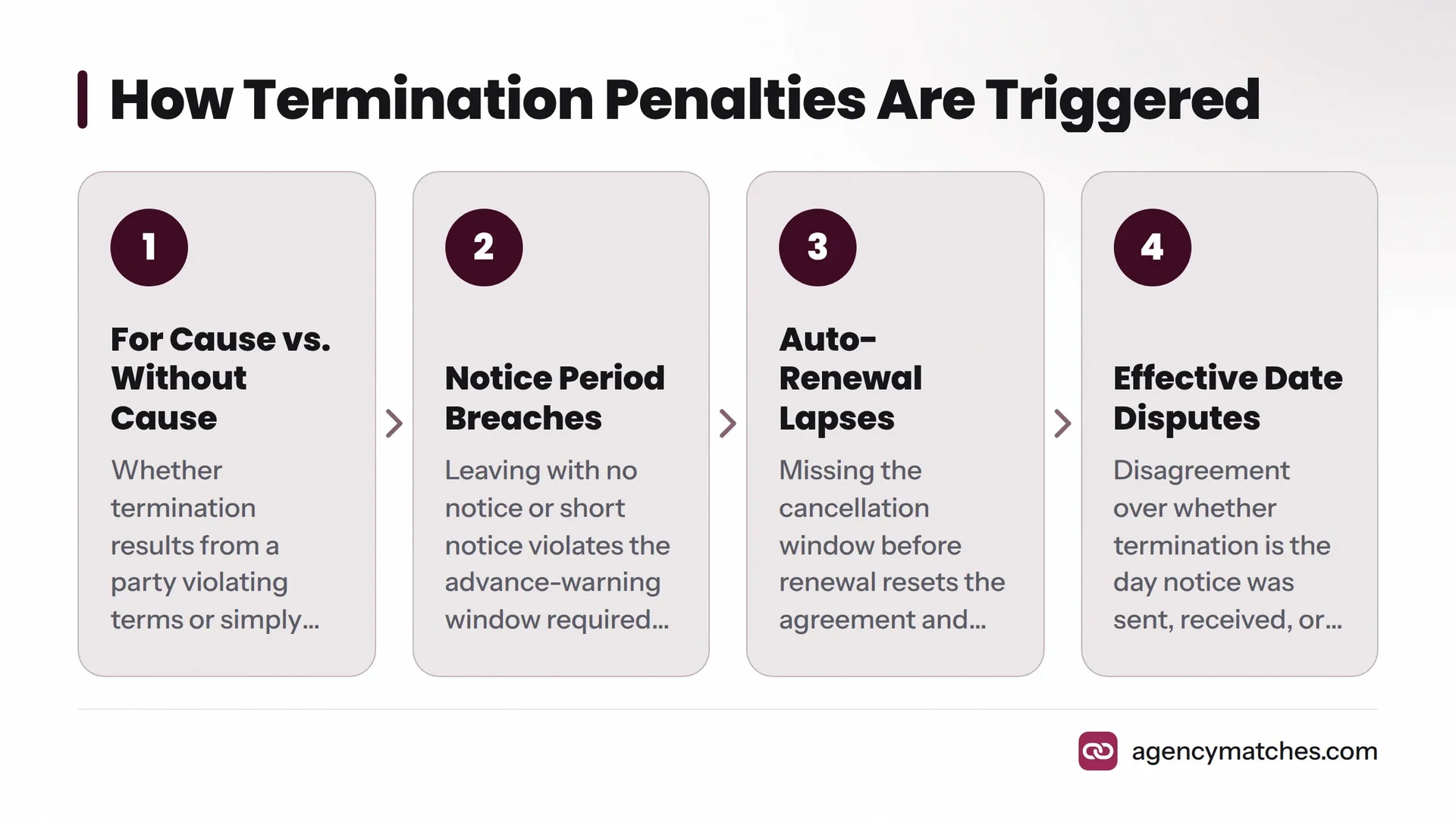
For Cause vs. Without Cause
Termination "for cause" means ending the agreement because one party violated its terms - non-payment, breach of exclusivity, failure to deliver agreed services. Termination "without cause" means either party ends the relationship without alleging a violation, often by giving notice as the contract allows.
The distinction matters for penalty exposure. Some agreements waive or reduce financial penalties when termination is for cause (the agency failed to perform), while applying the full penalty schedule when a creator exits without cause simply because they want a different agency.
Notice Period Breaches
A notice period is the advance warning a contract requires before termination takes effect. Breaching it - by leaving with no notice or short notice - is one of the most common penalty triggers in creator management agreements. The agreement itself defines how long that window is and what counts as valid notice.
Auto-Renewal Lapses
If a contract includes an auto-renewal clause, missing the cancellation window before the renewal date can reset the entire agreement. An exit that would have been penalty-free a week earlier suddenly looks like an early termination under a brand-new term.
Effective Date Disputes
The effective date of termination is the specific date the contract treats as the end of the relationship. Disputes over that date - whether it's the day notice was sent, the day notice was received, or the end of a required notice period - can determine whether a penalty applies at all. A short gap in interpretation can be the difference between a clean exit and a triggered penalty.
Hypothetical scenario: A creator signs a one-year agreement with a 30-day notice requirement and an auto-renewal clause that kicks in unless cancellation notice is sent 45 days before the renewal date. The creator sends notice 35 days before renewal, believing 30 days was the rule. Under the actual contract language, that notice arrives too late, the agreement auto-renews, and the creator is now considered to be exiting mid-term, exposed to an early termination fee that would not have applied had the notice gone out on time.
This is exactly the kind of date-driven dispute that dense contract language creates. Reading the renewal and notice sections closely matters more than reading the commission section.
What to Check Before You Sign
Before signing with a new agency or sending notice to leave your current one, review these specific sections:
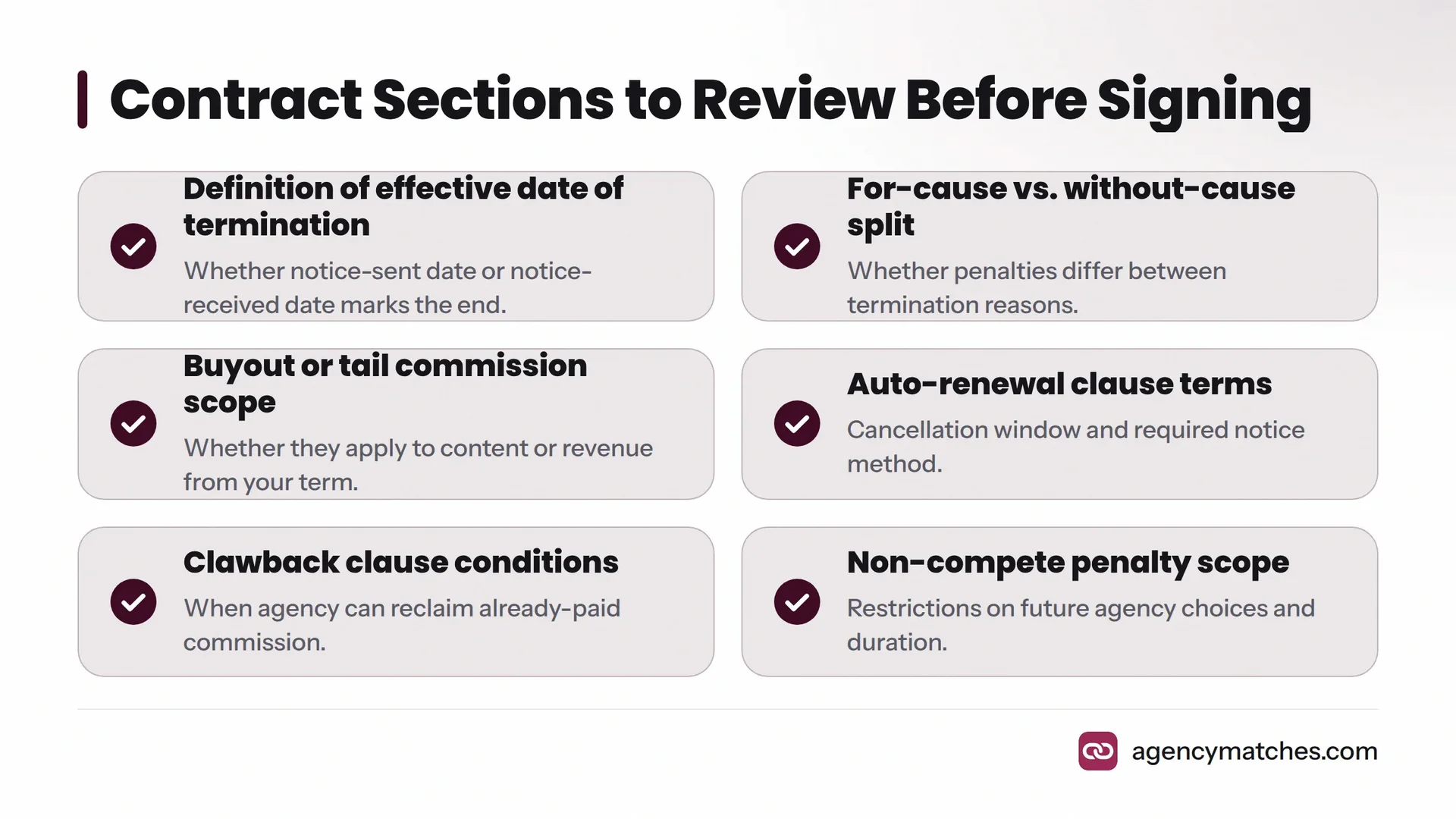
- The agreement's definition of effective date of termination - whether that's the date notice is sent or received
- Whether termination is split into for cause and without cause categories, and whether penalties differ between them
- Whether a buyout clause or tail commission applies to content or revenue generated during the term
- The exact terms of any auto-renewal clause, including the cancellation window and how notice must be delivered
- Whether a clawback clause lets the agency reclaim payouts, bonuses, or advances already paid to you, and under what conditions
- Whether a non-compete penalty restricts future agency choices, and for how long
A review of publicly available agency documentation shows real variation in how clearly these terms are disclosed. Some agreements spell out exit terms, notice windows, and penalty formulas in plain language. Others leave them vague or omit a defined notice period altogether.
That inconsistency is why reading the termination section of any agreement before signing matters as much as comparing commission rates. The practical checklist for choosing an OnlyFans agency covers what to look for before you sign in more depth, and published commission structures across agencies are tracked on the OnlyFans agency commission rates page for side-by-side comparison.
For readers comparing a specific current agency against alternatives, profiles like the Scissorzz Agency alternatives comparison show how published terms differ agency to agency, which provides useful context when deciding whether a penalty clause is typical or unusual.
Related Reading
This page focuses on definitions. For the practical side of reading terms before you sign, the practical checklist for choosing an OnlyFans agency includes a term-and-exit item to check, and individual agency profiles list published terms, including notice periods.
If you're still early in the decision, comparing options through Agency Matches and its directory of agency profiles, fees, and published terms is a reasonable first step before committing to a new contract.
FAQ
What is an agency termination penalty?
It's a financial charge, clawback, or contractual obligation that activates specifically because a management agreement is ending, distinct from the regular commission the agency earns while the relationship is active.
Can an OnlyFans agency legally charge me for leaving early?
Agencies can include early termination fees or liquidated damages clauses in a signed agreement, but whether a specific clause is enforceable depends on how it's written and the jurisdiction governing the contract. A licensed attorney reviewing your actual agreement is the only reliable source for that answer.
Do all agencies disclose their termination penalties upfront?
No. A review of publicly available agency documentation shows meaningful variation, with some agencies stating exit terms, notice windows, and penalty formulas clearly, while others leave these sections vague or omit a defined notice period entirely.
Can an agency claw back money already paid after I leave?
Yes, if the agreement includes a clawback or chargeback clause, which lets the agency reclaim payouts, bonuses, or advances paid to the creator, or recover commission lost to refunds and chargebacks. It typically activates on subscriber refunds, payment disputes, or a documented violation of the contract's terms. Whether a specific clawback is valid depends on the exact wording of the clause.
What happens if my agreement auto-renews without me noticing?
If you miss the cancellation window defined in an auto-renewal clause, the contract typically renews for a new term automatically, and an exit attempted afterward may be treated as an early termination even though you believed the original term had ended.
Is a termination penalty the same as a regular commission fee?
No. A commission fee is the agency's ongoing share of revenue while the relationship is active. A termination penalty is a separate charge or obligation tied specifically to the act of ending the agreement.
Are termination penalties negotiable before signing a contract?
Many contract terms, including penalty clauses, notice periods, and buyout provisions, can be negotiated before signing, though whether an agency is willing to adjust them varies. Asking directly before signing is the only point where negotiation is realistic.
Is this page offering legal advice about my specific contract?
No. This page explains common penalty types and how they're generally triggered, written for creators without a legal background. It is not a substitute for a licensed attorney reviewing your actual agreement.